Travel Guide and Transport Info for Phonsavanh and Plain of Jars, Laos by Hobo Maps -

We often use the French acronym "PDJ" (Plain des Jarres) to refer to the Plain of Jars which includes the town of Phonsavanh and the area around it, mostly to the south and west.

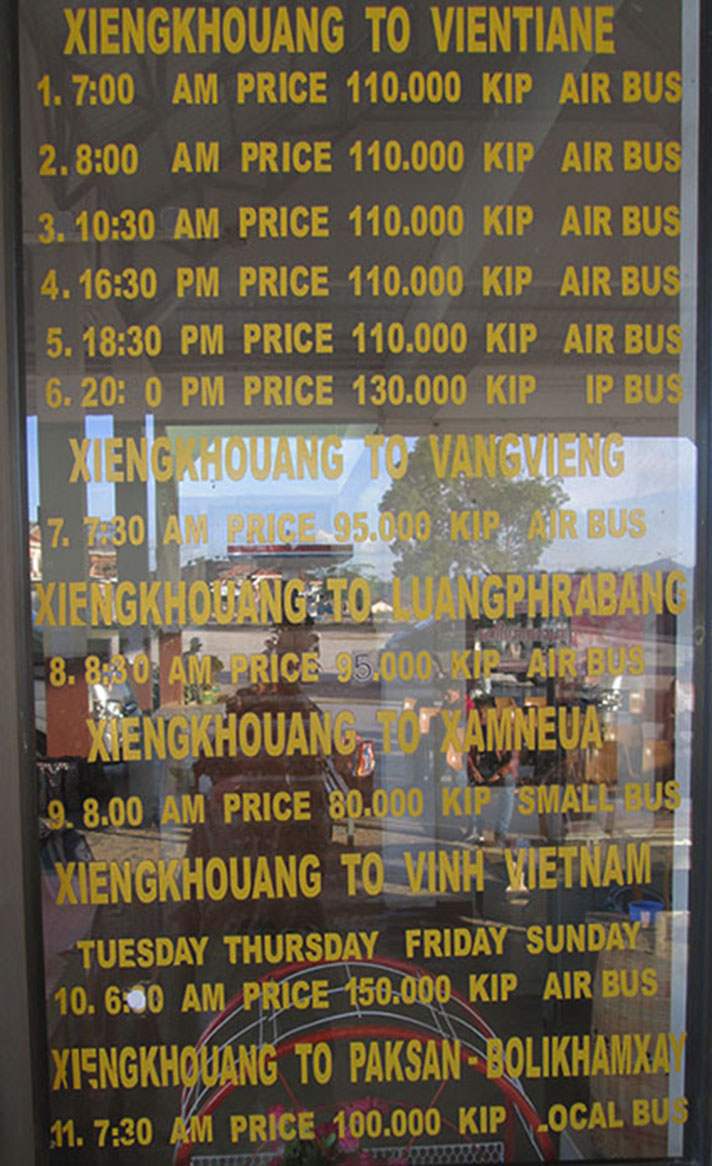
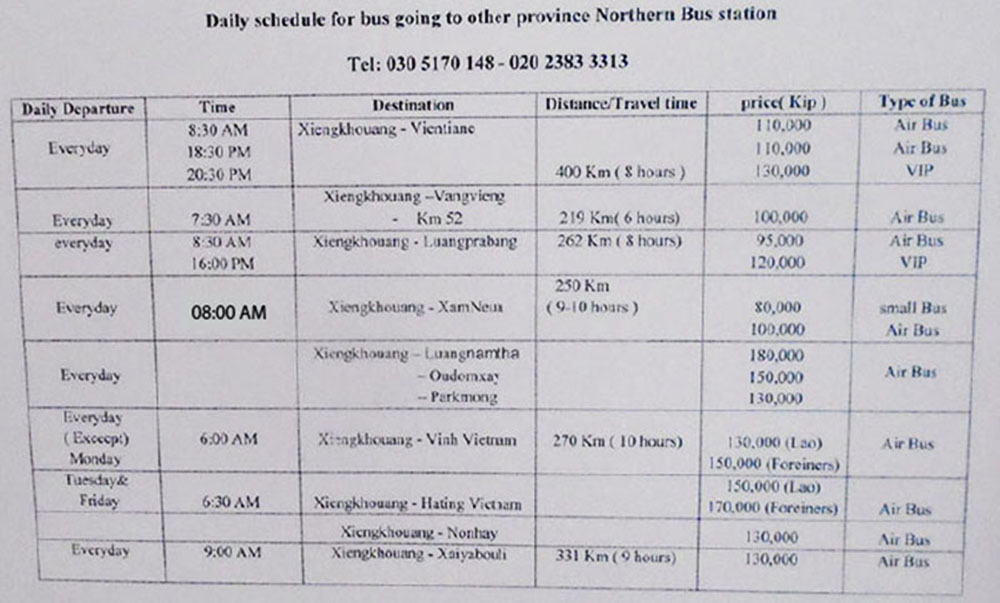
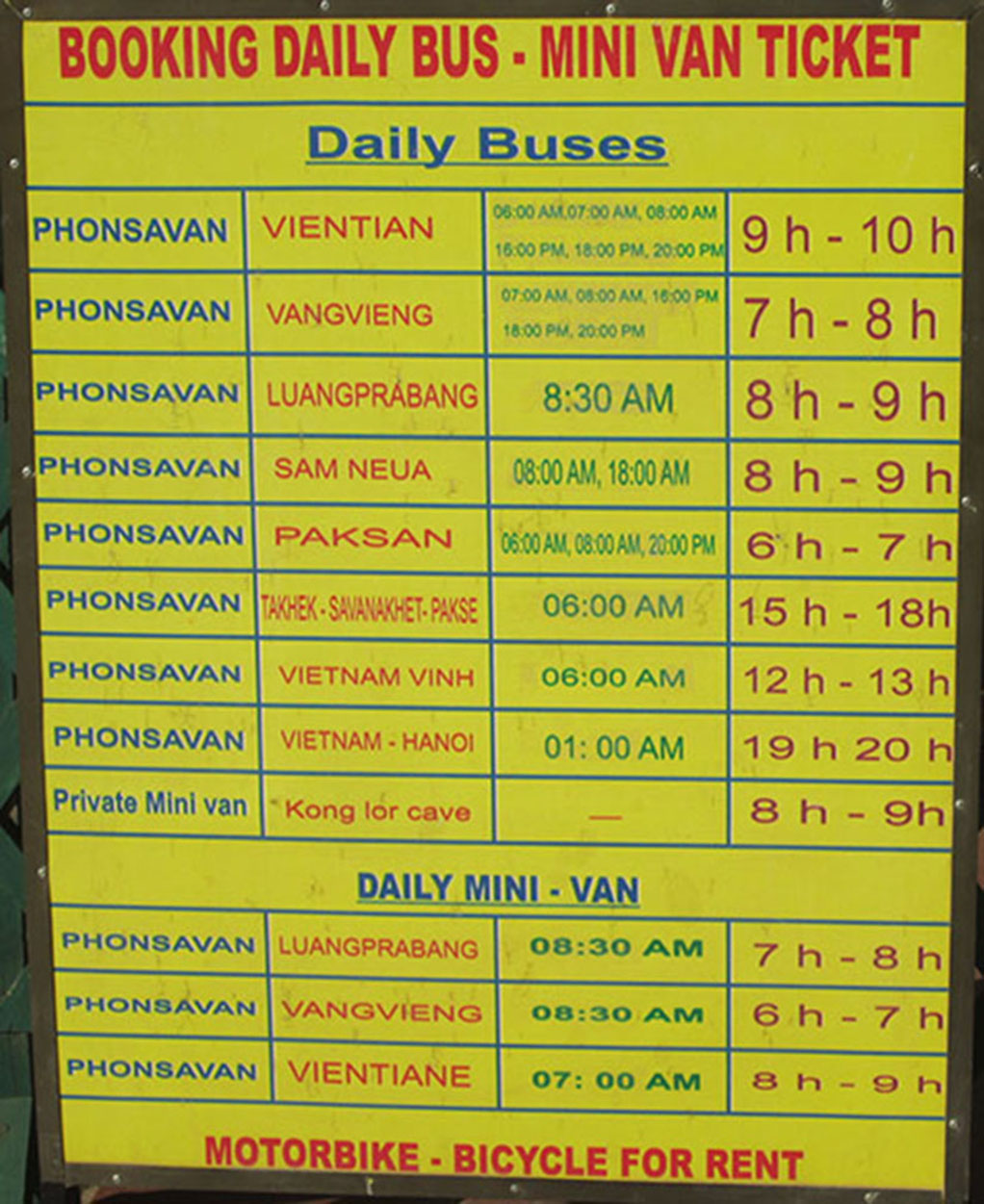
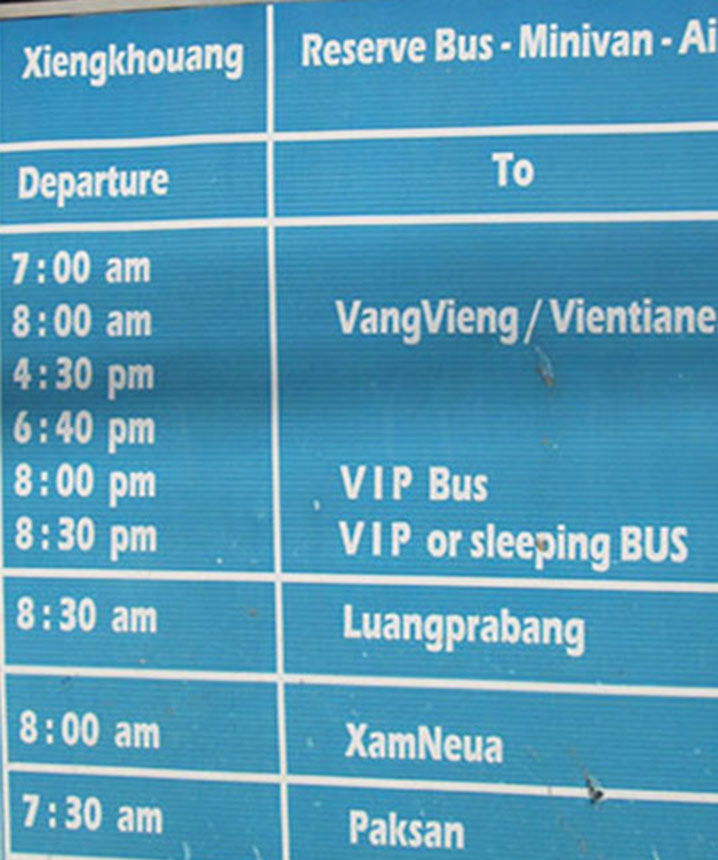
Getting to PDJ - most visitors arrive by bus via Hwy. 7 coming from the east after turning off Hwy. 13 at the Phou Khoun junction. Hwy. 7 is a fine paved road with little traffic that makes it attractive for cycling but unfortunately there is no nice reliable accommodation between Phou Khoun and Phonsavanh and the 135 km distance is too much for bicycling in one day for all but the most fit. Hwy. 7 also extends to Vietnam and along the way Hwy. 6 branches north to Sam Neua and Vieng Xay. Lao Airlines flights are available to/from Vientiane and Luang Prabang as shown in the schedule below. The flights to Vientiane may offer passengers nice low-altitude views from the air of the PDJ and the area south of it which is still not open for visitors to see by land transport. Direct bus service to/from PDJ is available from Vientiane, Vang Vieng, Luang Prabang, Sam Neua and Vinh, Vietnam.

Local Transport - the town of Phonsavanh is small enough to walk around but most other places of interest at the PDJ require some sort of transport. Bicycles and motorbikes are available for daily rental but only at one or two places so be sure to arrive as early as possible to get one. Tuk tuks are the main taxis for visitors and the drivers who gather at the central town area speak a little English. Songtaew buses go out from the bus stations to outlying areas but aren't usually used by visitors because tourism authorities restrict their use in taking visitors to the jar sites and other tourist attractions as they want visitors to go on organized tours or charter a minivan with a registered guide and driver instead.

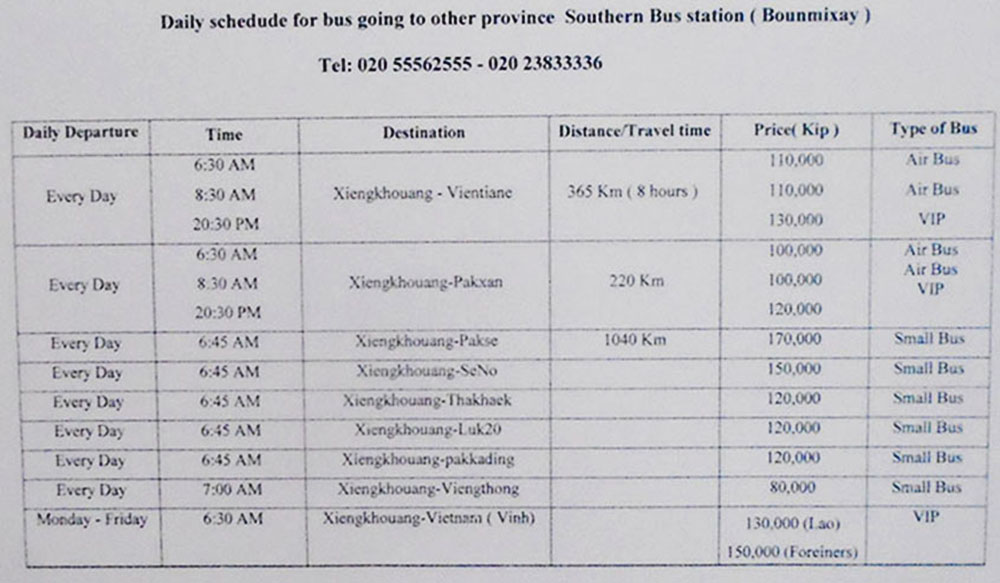
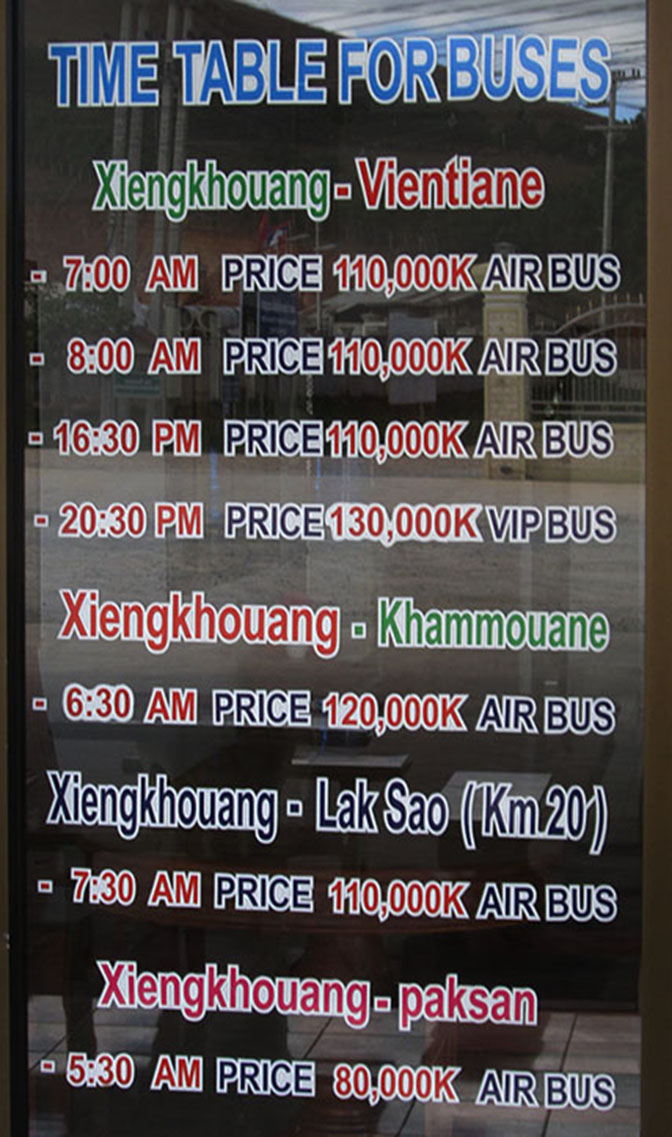
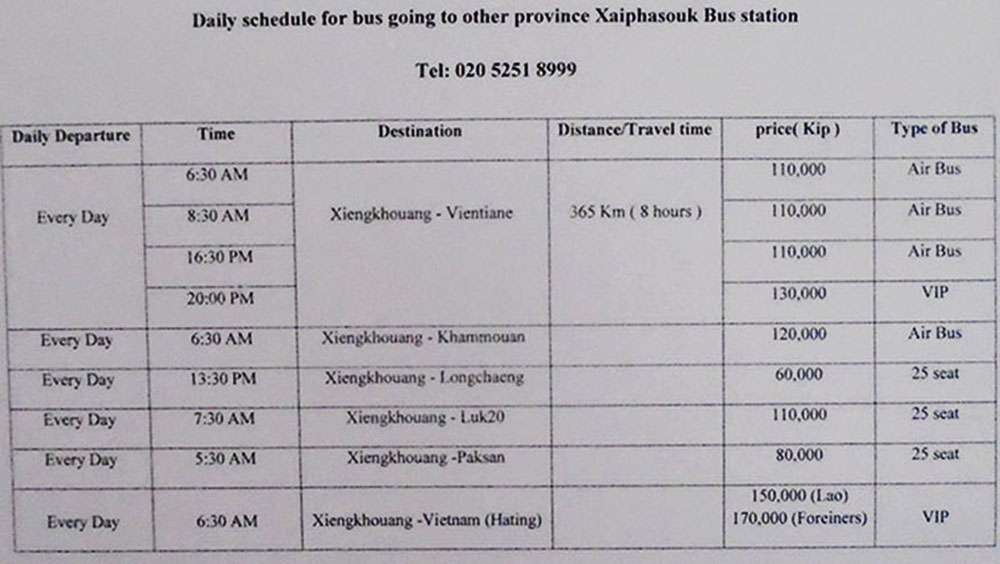
Long Distance Bus Service
- The Xieng Khouang Bus Station for long distance bus service to destinations outside of Xieng Khouang Province is located about 3 km northwest of central Phonsavanh near the km 133 marker on Hwy. 7 at grid code JZ218 on this map HERE. Older maps may still show it as being in central Phonsavanh but it has moved. Eastbound buses travel via Hwy. 7 to Phou Khoun at the junction of Hwy. 13 and then south to Vientiane & Vang Vieng or north to Luang Prabang. Westbound buses travel via Hwy. 7 to Muang Kham and north from there to Sam Neua or continue west on Hwy. 7 to Vietnam. One daily bus is scheduled to go southeast via Hwy. 1D to the old capital town Muang Khoun and then south on a miserable road to Paksan but this schedule may be interrupted during the wet season as there is ongoing major road construction that makes this trip uncertain until the construction is finished in 2013 or so. Highway 1D south of Phonsavanh is often referred to on other maps and on Google's internet maps as Hwy. 10 but the roadside markers all indicate it as 1D and since there is another Hwy. 10 going north of Vientiane towards Nam Ngum Lake we must assume someone in the past made a mistake in reading the roadside markers at the PDJ as the "D" does look a bit like a "0".

Local Bus Service
- Local buses to areas around Phonsavanh in Xieng Khouang Province depart from two different traditional markets, referred to as the "Wet Market" and the "Nam Ngam Market" on the bus schedules posted at the Provincial Tourism Office. English is a rare commodity at both local bus stations and it may be best to have a note in Laos prepared to show them where you want to go. Also be advised that the songtaew buses that go out of town on regular routes are not used to handling tourist passengers and may be reluctant to take them as they are not allowed to take tourists to the Jar Sites or other popular tourist destinations and this attitude may carry over to all destinations. Best to maintain a low profile and try to be unnoticed on these buses. The "Wet Market" is located in central Phonsavanh at grid code KE232 on this map HERE and is referred to on that map as Talad Phonsavanh. Songtaew buses depart from there to destinations east, west and north of Phonsavanh as shown in the schedule below. The Nam Ngam bus station is located at grid code KG222 on this map HERE where it is referred to as Talad Nam Ngam and it has buses mostly going to destinations south of Phonsavanh. Some other maps refer to this station and the lake near it as Nam Ngum but all the local signs refer to them as Nam Ngam (tourism office, post office, schools, etc.). We need to be careful using the term Nam Ngum because it's the name of the large lake north of Vientiane and the river flowing down to it.

the PDJ info below copied from MegaJarsLaos.com website - Visiting PDJ - Sept 2011

Description & Location - the Plain of Jars is not an officially designated area and has no clear boundaries but can be depicted as the gray-colored area seen on the satellite image we show on our MegaJarsLaos.com website home page HERE. It is a rather flat basin on a plateau located in Xieng Khouang Province northern Laos. The size is approximately 450 square kilometers - 10 to 20 km wide east to west & 30 km north to south.

Why Visit PDJ? - To stir the imagination. To see and explore a unique landscape with a unique history and unsolved mysteries. It's one of the most tortured landscapes on the planet that continues to suffer from mankind's ravages while also experiencing renewal efforts. You can stand on a hilltop today surrounded by megalithic jars and look out over a lowlands area that at one time may have been an ancient lake and imagine tree-covered hills surrounding that lake. Was this a scene that inspired ancient mankind to feel this was a mysterious place suitable as a site for carving hundreds of large megalithic jars out of solid rock? Then imagine how it can be that we still don't have any idea today who did all this. What must have been a large and rather prosperous civilization has simply vanished without leaving us anything other than the jars. For those with wild imaginations we can think about those strange softly-rounded mounds scattered about the PDJ and wonder if it's their appearance or something else that makes the PDJ landscape different than other landscapes in Laos. Could they really be moraine mounds of deposited glacial debris formed at the ends of mini glaciers that came down from the surrounding hills in a former ice age? Could these rivers of ice also have brought down stone boulders and deposited them atop these mounds? Were these boulders carved into some of the megalithic jars we find today on some of these mounds? Could a glacier also have blocked the flow of water out of the PDJ and created a big shallow lake? Was such a lake useful for transport of the jars? The area may have been covered with opium poppy cultivation at times and mulberry tree cultivation for silkworms and silk production at other times. Imagine long distance trading caravans from China and Vietnam crossing the PDJ and stopping to trade on their way to India and western areas.The Haw raiders from China repeatedly swept down to terrorize the people and carry off anything of value. Imagine the massive bombing campaign carried out by US military in the 1960s & 1970s Secret War in Laos making this the most heavily bombed place on the planet. You can still see many of the larger bomb craters and crews continue clearing the UXO. Imagine the back and forth battles between the Pathet Lao and Vietnamese allies and the US-backed Hmong under Vang Pao and the Thai mercenaries. A massive reforestation campaign is ongoing today with eucalyptus trees and a type of pine tree aparently not native to Laos which adds to the uniqueness of the PDJ landscape. Finally we can imagine what the PDJ may look like in the future after the reforestation has matured and forests once again cover the hills. Maybe a dam will be built on the Nam Kho river (which is the only drainage outlet for most of the PDJ) and once again create a shallow lake over portions of the PDJ. Visitors may then be taken back in time visually and see the area as the ancient people who carved the jars may have seen it.

Why Not to Go to PDJ - The PDJ today still has dangerous UXO lying about which has not been cleared and people who want to wander about anywhere to explore off-road areas are advised to find some other place to do it as visitors sould stay on roads and well-trodden pathways. Phonsavanh is the only town of any size on the PDJ and there's no nightlife - not a place for party animals. Gourmet diners will be disappointed as will those seeking ancient cultural experiences. Shopping is limited and not great value. Very few temples still exist and none seem to have interesting architecture or ancient history. Phonsavanh is a relatively new town developed after the older capital at Muang Khoun (then known as Xieng Khoung) was totally destroyed by US bombing in 1969. Wat Piawat at the old capital has partially survived and is photogenic but little remains. Trekking is limited to areas already cleared of UXO and well-trodden paths. Water sports are also limited with no organized kayaking or tubing and swimming (wading actually) is limited to ponds near caves or waterfalls.

When to Go, Seasons & Weather - as with the rest of northern Laos the rainy wet season runs from June through November and the dry season from December through May. Even during the middle of the wet season it seldom rains all day and mornings tend to get less rain than other times of the day. Because of the elevation, nights are cool and refreshing while clear sunny afternoon days can be hot any time of year. Hotel & guest house rooms seldom have any type of heating and it can get quite cool inside your room during December & January when you might want to bring an extra bedding sheet, a sweater and a good hair dryer to act as a small space heater. Many of the roads outside of Phonsavanh are not surfaced yet so it may be muddy going in the wet season and you may have to wade across streams or thru water accumulated on the roads. April and May can be quite hot and hazy with smoke from burning activities. The PDJ doesn't yet get large numbers of visitors and we have never encountered a time when finding available accommodation was a problem, even over the Christmas and western New Year holidays. The Hmong New Year festivities usually occur in December and January and continue for 2 or 3 weeks or more.

Tourist Info - there is a Provincial Tourism Office in Phonsavanh near Talad Nam Ngam market at grid code KG222 on this map HERE. The town has many travel agents and tour guide places in the central area.

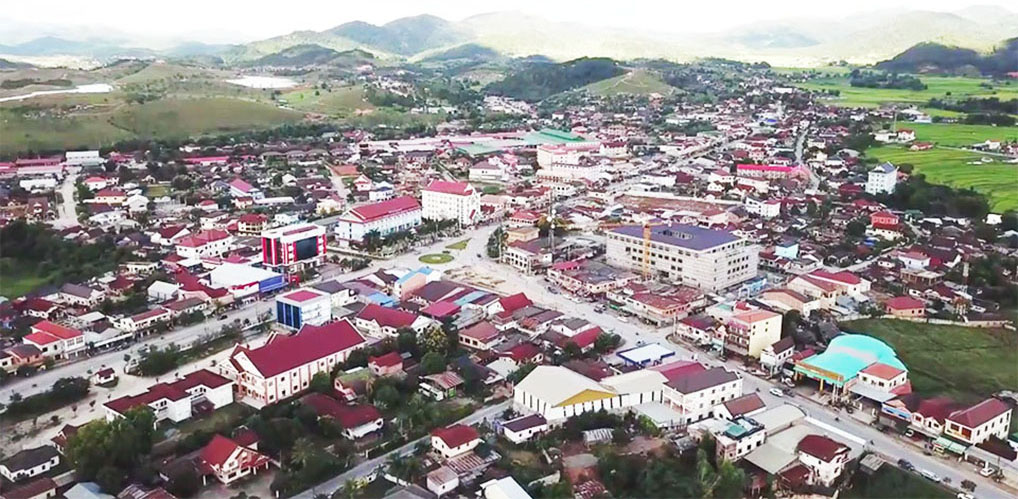
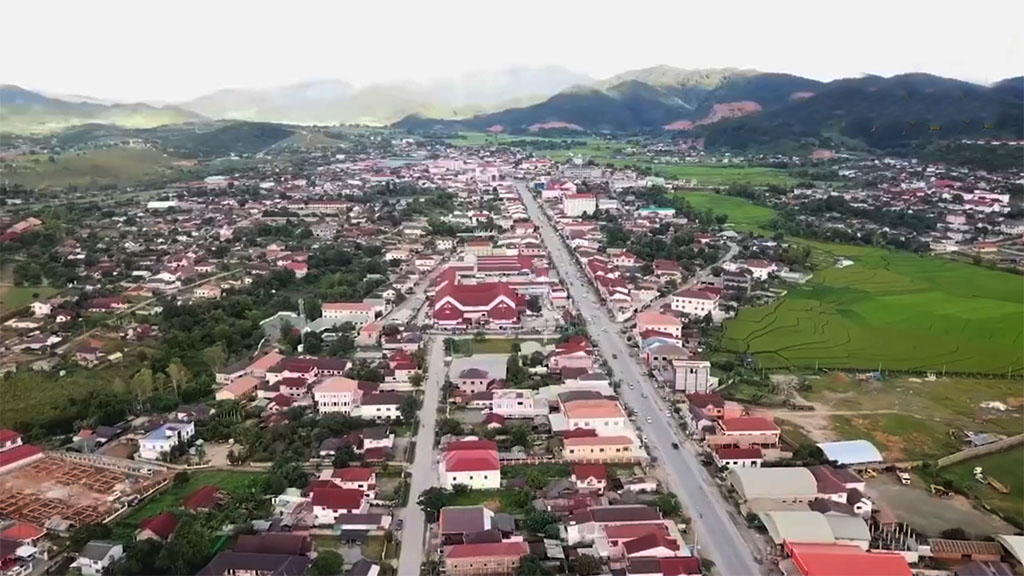
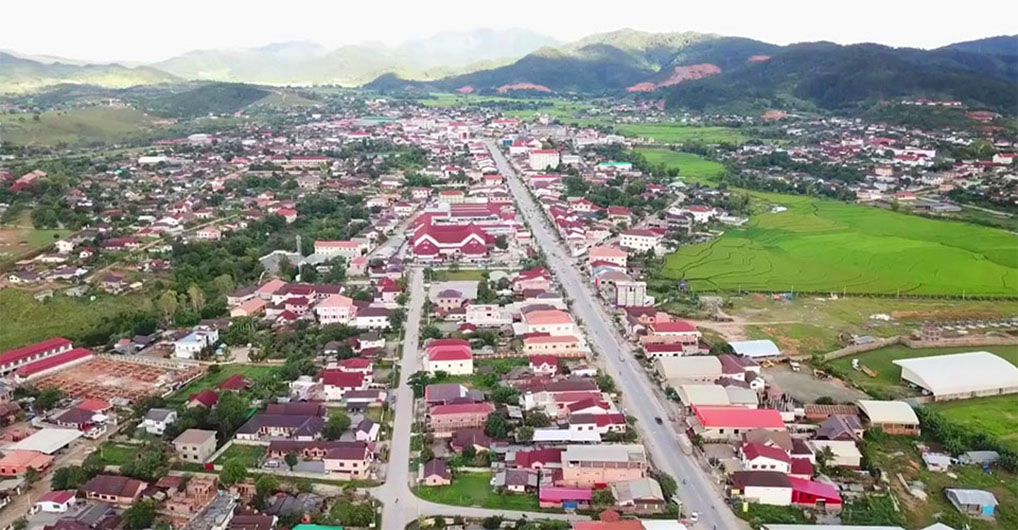
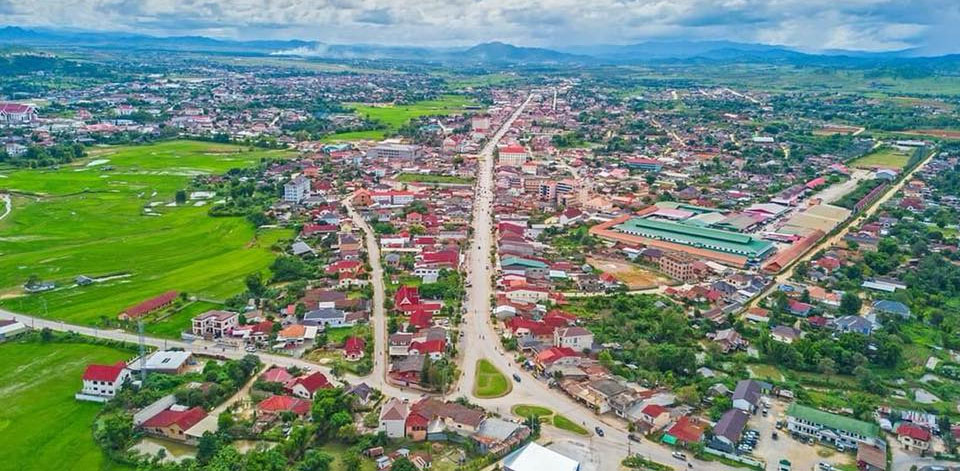
Phonsavanh town in the past has been rated poorly by some visitors as a place with dusty dirt streets and a wild west atmosphere but all that has changed and it's now a nice quiet place with most streets newly paved, new sidewalks, streetlights and even new traffic signals. The general archicture is still uninteresting. It's a newly-built town established after the old capital was destroyed in the Vietnam War era, the Secret War in Laos. Not much to do in town but it has all the typical tourist services and continues getting better and nicer.

Accommodation - as of May 2011 there were over 60 places of visitor accommodation at PDJ with nearly all in Phonsavanh town. See our Phonsavanh map and separate index of accommodation places HERE. More new places are under construction. Prices are reasonable and quality is fine with good reliable electrical and water service.

Hiking & Cycling - the PDJ has not been known in the past as a great place for hiking or cycling, in part due to fears of UXO and the lack of good maps showing safe areas for independent exploration. Local guides and travel agents don't make money from these activities and hence the lack of promotion. But Hobo Maps now has an up-to-date detailed map on it's website at hobomaps.com that may change things. Because so few visitors go out on their own, local people are curious and friendly when they see cyclers on the back roads and small kids even seem a bit fearful at first out of shock. But that's what makes this a great time to go. I suggest starting with renting a bicycle or motorbike and taking the back roads route from Phonsavanh town to Jar Site 3. This is clearly noted in several places on the PDJ Hobo Map HERE. Unfortunately this map isn't in commercial print form yet so you may have to print your own map from views taken from the website map. We suggest using the "Print Screen" option on your computer to print copies of what is displayed on your computer monitor and it might take 3 printed pages of 3 different displays to get the full route. Short half-day hikes from town can be made to the cemetery hilltop north of town and the Vietnam and Laos Memorial hilltops south of town. All have great panoramic viewpoints as a bonus. A nice shady quiet walk is south of town along Lovers Lane up and down a tree-covered ridge.

Visiting Jar Sites Without a Guide
Jar Sites 1, 2 & 3 are open to the public at 10,000 kip per person payable at the sites (5,000 kip for Lao people). Site 1 is about 10 km from central town on paved roads but Sites 2 & 3 are much further south on rough dirt roads much of the way (as of May 2011). It's about 24 km to Site 2 and 30 km to Site 3 from central town one way. A trip out to see all 3 sites would be about 38 km on the way out (including side trips to Sites 1 & 2) and 30 km back without side trips for a 68 km round trip total, with about 28 of that one nice paved roads and 40 km on rough dirt roads. Trying to visit all 3 sites by peddle bicycle in a single day is too much unless you find a songtaew or other transport to haul you and the bike back. The Jar Site locations and the routes to them can be seen on this map HERE.

Visiting Jar Sites on Guided Tour
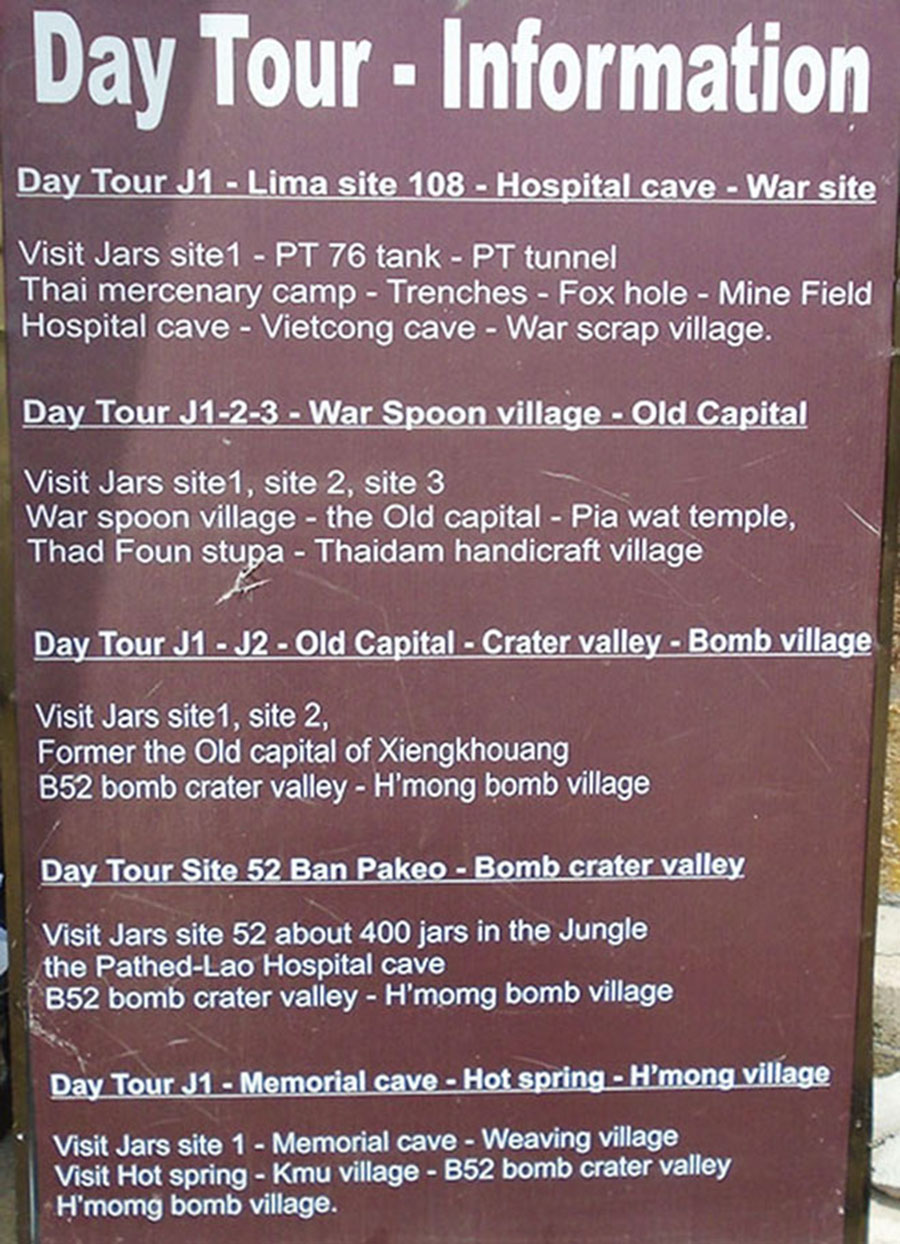
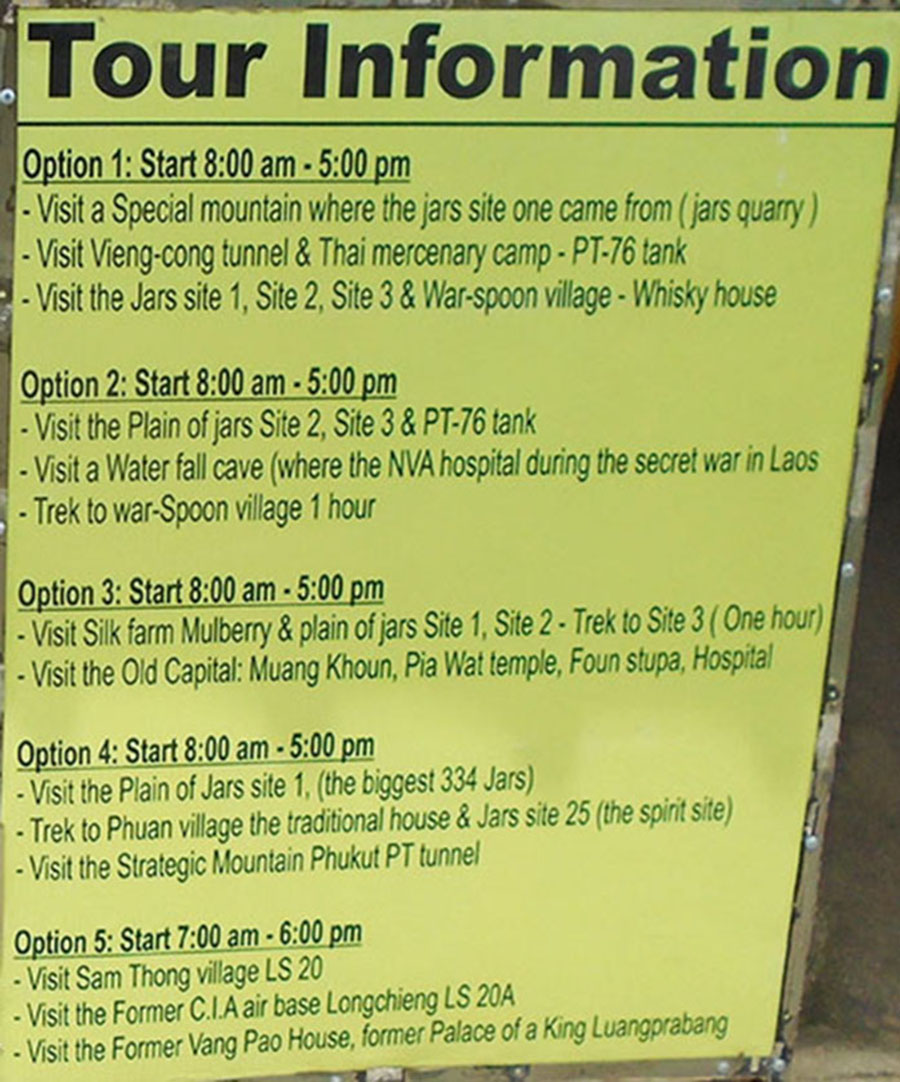
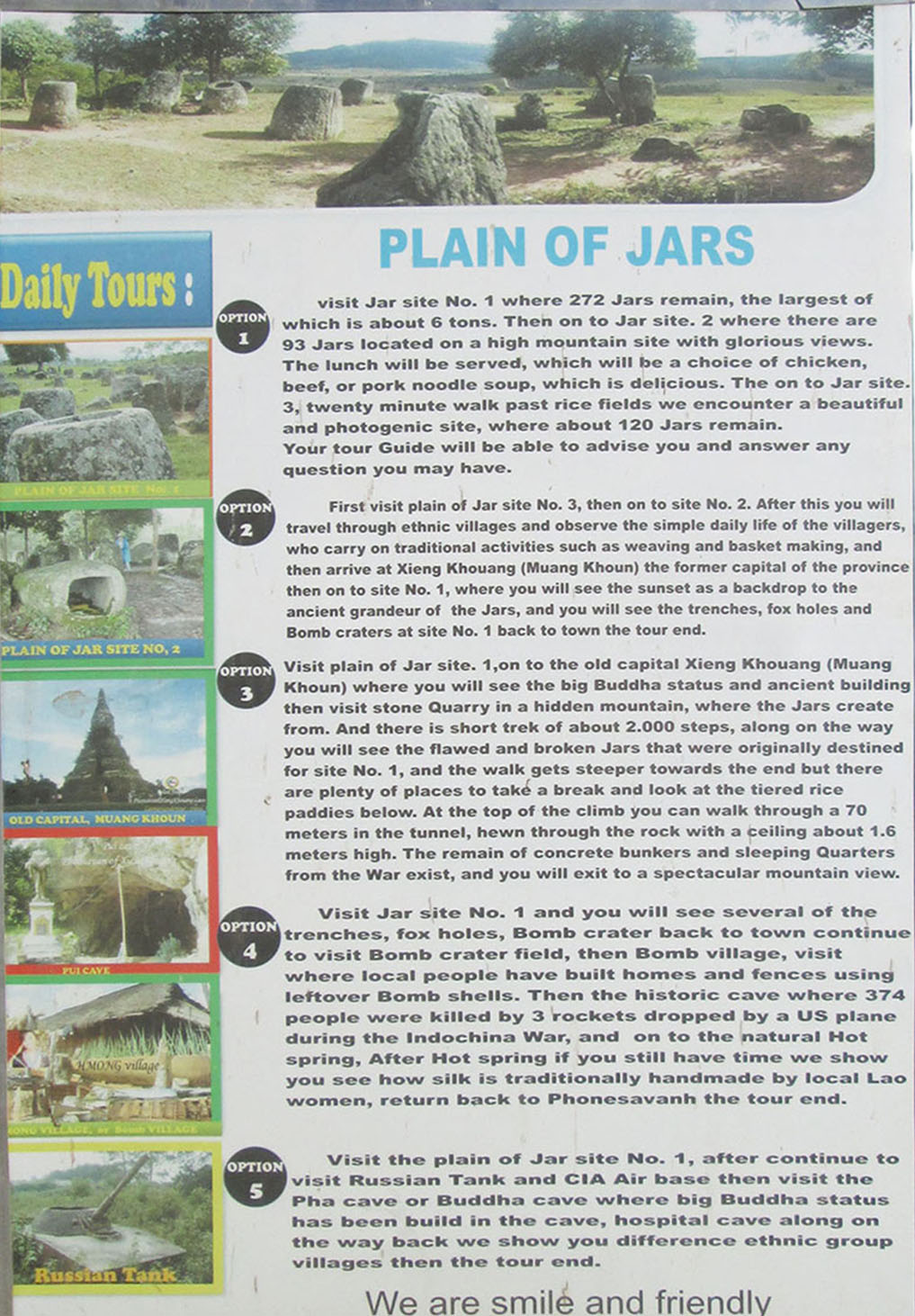
Several tour agencies have daily tours to Jar Sites 1, 2 & 3 along with stops at the Provincial Tourism Office, Whiskey Village and a Russian tank shell. Cost was about $20 US in 2010 and is good value as the tours take most of the day and include all entrance fees and a noodle soup lunch at Site 3. If the weather is good we suggest asking the guide to let you walk the path between Sites 2 & 3 along a scenic ridge instead of riding in the minivan. If time is running short and the guide is reluctant to take the walk, offer to skip the Russian tank visit on the way back to make up time as it’s only a partial shell and not much to see or photograph.

Some Jar Sites other than 1, 2 & 3 are open to visitors but we’ve had no luck getting organized tours or guides to take us to them as they’re further away from town and far apart. Some quarries are also open and cleared of UXO but not part of tours yet. If you want to see these other Jar Sites and Quarries we suggest you organize your own group of 5 or more persons, go in the dry season (Dec. thru April) and be willing to walk long distances.